
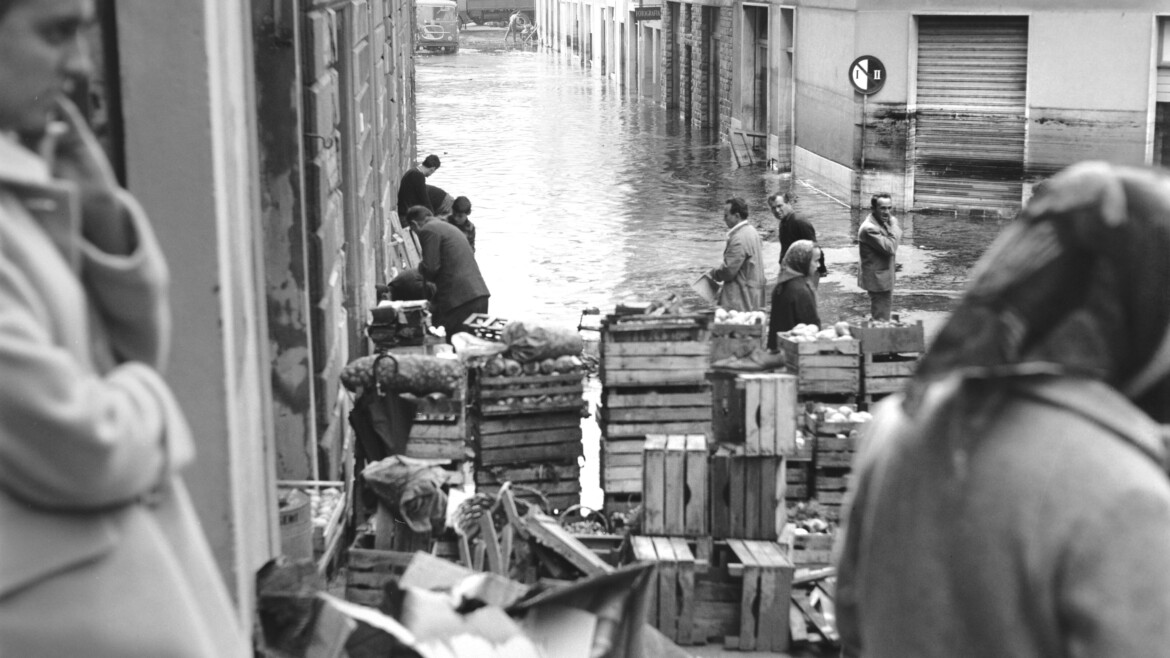
Sixty previously unpublished photographs on display at the Cambio Cultural Centre, alongside a screening of Jaurès Baldeschi’s documentary “CASTELFIORENTINO: 4 NOVEMBER 1966”.
The toll in Castelfiorentino was heavy: four people died and damage totalled over 5 billion.
The 1966 flood: sixty years on, memories and dozens of previously unpublished images continue to emerge of the tragedy that shook the community of Castelfiorentino (one of the worst-hit towns in the Empolese Valdelsa area) on that Friday, 4 November. The raging waters literally devastated the municipal area, destroying homes, shops, craft workshops and industrial premises, with a tragic toll: four deaths and over five billion in damage.
To commemorate this tragic event, a number of initiatives will take place in Castelfiorentino as part of a wider project, which includes the screening of a ‘restored’ documentary film and an exhibition featuring no fewer than sixty previously unpublished photographs at the Cambio Cultural Centre (from 4 to 18 November).
The documentary, filmed by Jaurès Baldeschi using an 8mm camera, traces every stage of the flood: from the early hours of the morning, to the moment the River Elsa burst its banks, to the current carrying all manner of objects, as well as the destructive effects on the housing stock and the area’s productive, craft and commercial fabric.
Also worth noting are sixty previously unpublished photographs by Jaurès Baldeschi, who, in addition to the film footage, used 14 rolls of film to capture 168 images; these will be on display for the first time as part of a comprehensive selection of 60 photographs at the Cambio Cultural Centre.
“In September 1966,” recalls Jaurès Baldeschi, “I was looking at the photos of Andrea Chenier at the Teatro del Popolo starring Umberto Borsò in the Bastianoni shop window, when my eye fell on some 8mm film and photographic film which, as they were nearing their expiry date, were being offered at a 50 per cent discount. As I’d bought a film camera some time before, I decided to buy them all in one go.”
“On the morning of 4 November,” continues Baldeschi, “I began filming the water flooding the village. The following day, when the waters began to recede, revealing the devastation they had caused, I also used my camera until I ran out of film. Absorbed by the task of editing the film, the negatives from 14 rolls of film were forgotten in a drawer, only to resurface several decades later. And so it was that Antonio D’Ambrosio printed the contact sheets, discovering previously unseen images that nobody had ever seen before. Today, thanks to the support of the Ente and Banca Cambiano, it is possible to view a wide selection of these images and, above all, to watch the restored documentary in extraordinary quality.”
The initiatives marking the 60th anniversary of the Flood form part of a project presented by the Angelo Azzurro UICC Film Club (and its artistic director, Jaurès Baldeschi), produced by Banca di Cambiano 1884 Spa and Ente Cambiano Spa in collaboration with the Municipality of Castelfiorentino, the Fondazione Teatro del Popolo, the Cambio Cultural Centre and the Giglio Rosso Photography Group, with the support of the Ciapetti haberdashery and Unipol.
The programme is due to be presented on 4 November – at 4.00 pm – in the ‘Sala Parlavecchia’ at the Cambio Cultural Centre, followed by the exhibition opening. The screening of the documentary, meanwhile, will take place at the Ridotto del Teatro del Popolo at 6.00 pm. “This film and the dozens of images that accompany it,” observe the Mayor, Francesca Giannì, and the Councillor for Culture, Franco Spina, “document, 60 years on from that event, our history (which is the history of all humankind), inviting us to build upon the blank slate of the unforeseeable and to remind ourselves, always, of our courageous fragility.” With a keen eye, Jaurès Baldeschi has captured the fury of the water as it surges forth and destroys everything in its path – what was there a moment before, and is now no more. A ‘pure’ film, a work of radical experimentation that finds its cornerstone in the aesthetics of the unexpected and the imperfect image. A scene of the moment-after-fear that perfectly embodies that perception of the ‘terrible’ of which Rilke wrote, whereby existential anguish merges with the beauty of the sublime through an encounter with that which is immense and transcends our understanding, such as death or the deepest nature of the universe.”
‘Sixty years on from the flood,’ notes Paolo Regini, Chairman of Ente Cambiano Scpa, “these images bring back not only the memory of an event that left a deep mark on Castelfiorentino, but also the face of a community, its places and the people who lived through them. Recovering, restoring and making such records accessible means preventing a part of our history from being lost and, above all, passing it on to future generations. This is one of the commitments that Ente Cambiano feels most strongly about: preserving the memory of the local area and helping to keep its cultural and human heritage alive. This is why we have wholeheartedly supported a project born out of collaboration between many local organisations, capable of transforming personal memories and artefacts that had long remained hidden into a heritage shared by the whole community.”
“Remembering the 1966 flood in Castelfiorentino,” observes Maria Cristina Giglioli, director of the Cambiano Foundation, which manages the Cambio Cultural Centre, and president of the Teatro del Popolo Foundation in Castelfiorentino, “is important because these images keep the memory alive. We are delighted to contribute to a highly significant project which, through these photographs, keeps that tragic history relevant and turns remembrance into an opportunity for everyone to learn.”