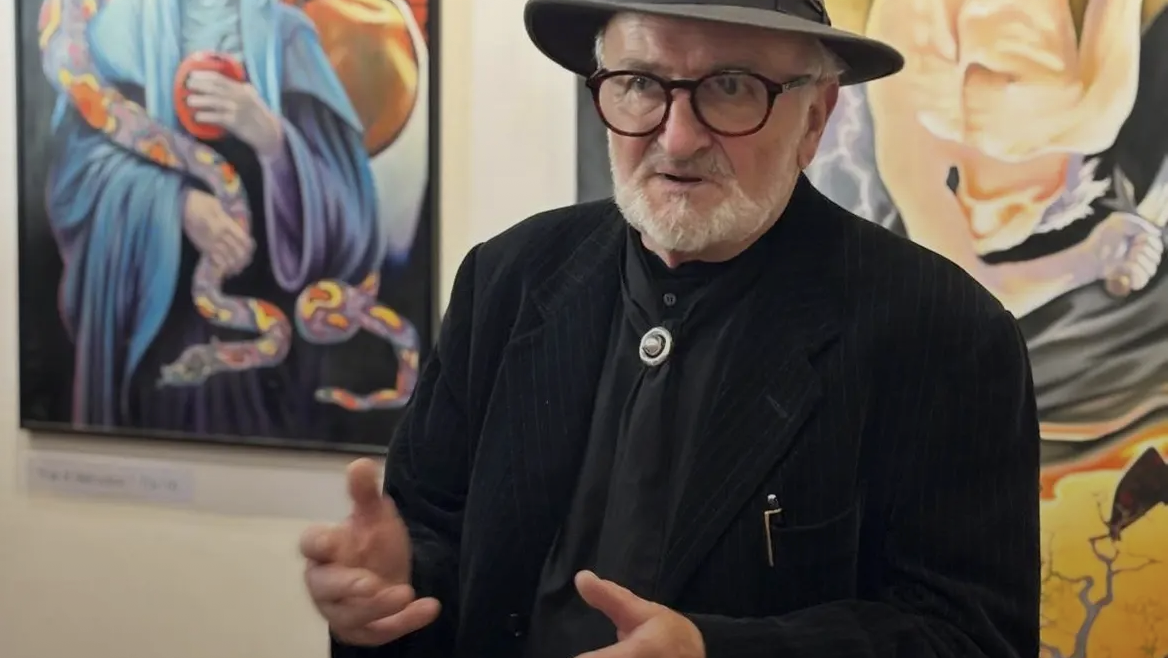
From today (3 June) until 31 October, the Chapel of the Visitation will be transformed into a communal space where Renaissance art and contemporary art forms come together.
The chapel, which originally housed a famous fresco by Benozzo Gozzoli, opens its doors today to the artist Nico Paladini, who will transform it into a creative space for experimentation and dialogue between Renaissance art and contemporary artistic languages. This, in short, is the aim of ‘Believe. Painting the Tabernacle from Benozzo Gozzoli 1491 to Nico Paladini 2026’, the second phase of a project launched in 2025 which, until 31 October, will see the artist set up a sort of “Atelier” within the Chapel of the Visitation, open to the public – a place where visitors can follow the various stages of his artistic intervention, centred on the Metropolism movement he himself founded.
Conceived around the idea of a symbolic “return” of Benozzo Gozzoli to the original sites of his works, and as a return of citizens to recognising these spaces as defining, culturally fertile, and capable of generating new interpretations, the artistic project will be explained in detail by Nico Paladini during a seminar, open to all, to be held at the Be.Go. Museum (Via Testaferrata) on Saturday 6 June, from 6.00 pm onwards.
Speakers at the event will include the Mayor, Francesca Giannì, the Councillor for Culture, Franco Spina, and the President of the Fondazione Teatro del Popolo, Maria Cristina Giglioli.
In accordance with the project guidelines, the Chapel of the Visitation will be clad in black, intended as a generative matrix capable of amplifying the evocative power of the images and the works on display. The exhibition, which is designed as an immersive experience, will explore the theme of birth and rebirth, concluding with a critical reflection on contemporary society. The various stages of the project will be documented by the “Giglio Rosso” association through photographs and video footage.
Furthermore, starting from Sunday 7 June, “Art Workshops” will be launched at the Chapel of the Visitation, open to the public (teenagers, adults, vulnerable elderly people), where participants will learn artistic techniques such as “collage” and “gold leaf” and will be involved in creating square panels to be incorporated into a modular composition to be installed in October on the wall behind the tabernacle, under the supervision of the artist Paladini and staff from the Be.Go Museum. The sessions will take place on Sunday 7 June, Saturday 13, Saturday 20 and Saturday 27 June in two time slots: 1st slot 3.00–4.00 pm, 2nd slot 4.30–5.30 pm (info and bookings: 0571 64448, 333 3302866)
In July, once the art project has been completed, the Chapel of the Visitation will open its doors two afternoons a week, thanks to a partnership with the “Sveliamo La Marca” Association, with the aim of making it accessible to a wider audience and encouraging its use by tourists as well. Between September and October, special public openings will continue and, at the same time, workshops will begin at the Be.Go. Museum with schools from the Comprehensive School District. Finally, in October, the public handover ceremony for the project will take place, conceived as a collective and participatory performance. All the panels created during the workshops will be placed on the wall behind the tabernacle, around the portrait of Benozzo Gozzoli by Nico Paladini, creating a collective and permanent artistic installation, with the aim of strengthening the sense of belonging to the community stimulated by the artistic dialogue between the past and the present. The Orpheus Association will accompany the event with a live musical performance.
The project “Be.Go.Back 2. Benozzo Gozzoli 1491–Nico Paladini 2026” is promoted by the Municipality of Castelfiorentino and the Fondazione Teatro del Popolo, with the support of the Fondazione CR Firenze, in collaboration with the “Giglio Rosso” Association and the “Sveliamo La Marca” Association.
“Benozzo Gozzoli, the genius loci of the Valdelsa, as Paolucci so aptly put it,” emphasises the Mayor, Francesca Giannì – “once again makes his symbolic presence felt in the Chapel where one of his famous frescoes was created, now on display at the Be.Go. Museum, thanks to the contemporary art of Nico Paladini, as part of an initiative launched last year that aims to rediscover and promote the lesser-known cultural sites of our region. An artistic project that aims to involve young people and adults, teenagers, students and frail elderly people in the creation of a collective work which, drawing on the past, will project itself onto our present, stimulating creativity, a sense of belonging and a new awareness of the richness of our historical and artistic heritage. “Our thanks go to the Fondazione Teatro del Popolo, which has made this project possible, to the Fondazione CR Firenze, which has supported it, and to the local associations that will take part with their expertise, willingness and professionalism.”
“This project,” notes the Councillor for Culture, Franco Spina, “stems from the idea of culture within everyone’s reach, based on experience, discovery and sharing. It is a means of re-establishing ties with the local area, reclaiming a sense of identity and building a new spirit of community. It is a reterritorialisation, to borrow from Deleuze, of a space that once again becomes a lived-in place thanks to the rebuilding of a bond with the community, the recipient and co-protagonist of this story. In a few weeks’ time, the Chapel of the Visitation will once again become, through Nico Paladini’s artistic intervention, a place lived in by us, the people of Castelnuovo: a new artistic initiative to be nurtured together.”
“Supporting BeGoBack 2,” notes the President of the Fondazione Teatro del Popolo, Maria Cristina Giglioli, “means, for the Fondazione Teatro del Popolo, betting once again on a culture that is open, participatory and capable of shaping the local area and the people who live there. Seeing the Chapel of the Visitation come back to life as a dynamic space for experimentation, where past and present meet thanks to the active involvement of citizens, schools and associations, confirms just how much art can unite and, at the same time, enhance our community.”
