Permanent installation by Aronne Pleuteri at Coiano Castle
from 22 September 2026
WONDERFUL! ART RESEARCH PROGRAM – MARIA MANETTI AND JAN SHREM FOUNDATION
A new permanent artwork for the Via Francigena region and its community is being unveiled at Coiano Castle: a playful installation, conceived as a hybrid of theatre, road sign and think tank.
A site-specific installation created as part of the second edition of the WONDERFUL! Art Research Programme – Maria Manetti and Jan Shrem Foundation
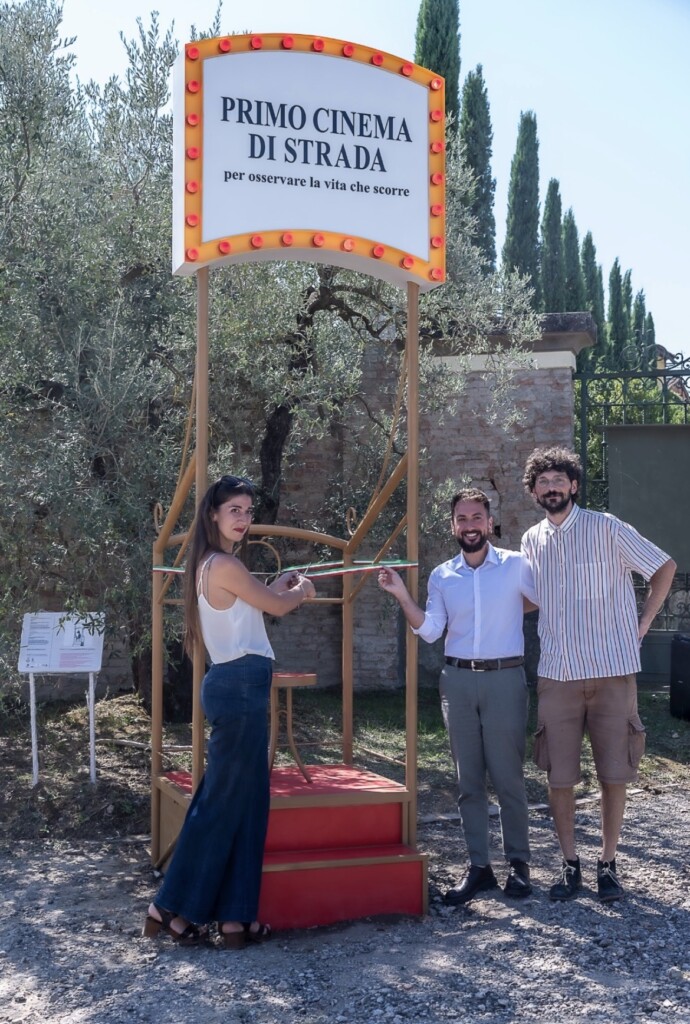
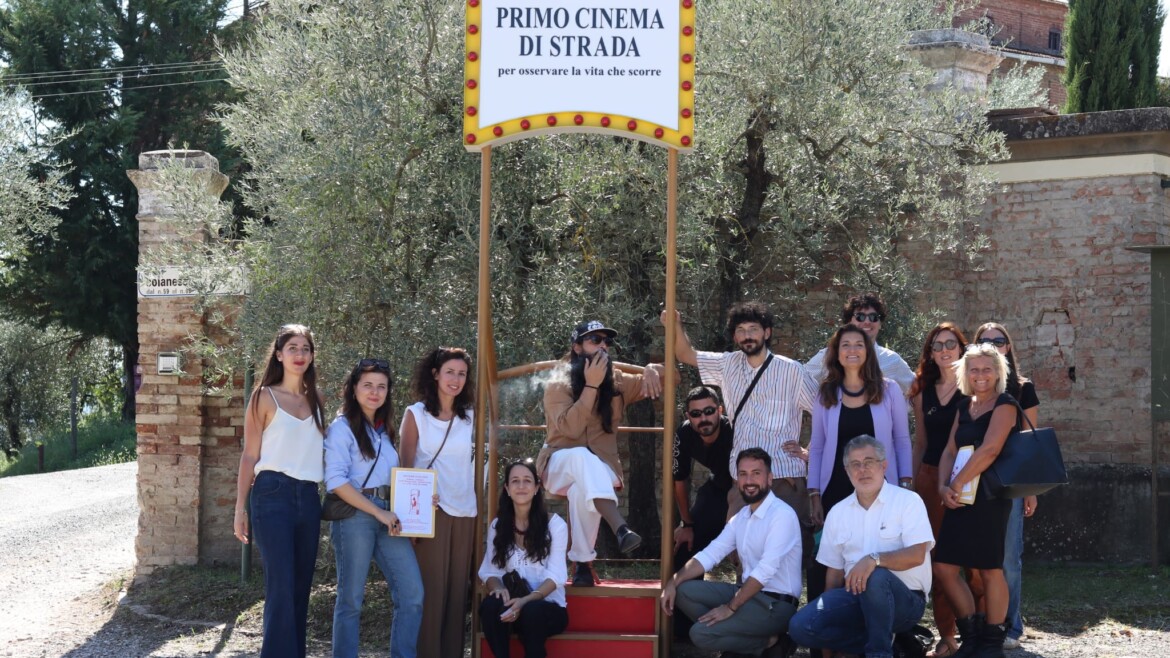
A small canopy, a stool, a neon sign. No actors, no set design, no performance. And yet, for those walking the Via Francigena and passing through the hamlet of Coiano, something catches the eye: PRIMO, a street cinema for observing life as it unfolds – the new site-specific installation by artist and performer Aronne Pleuteri.
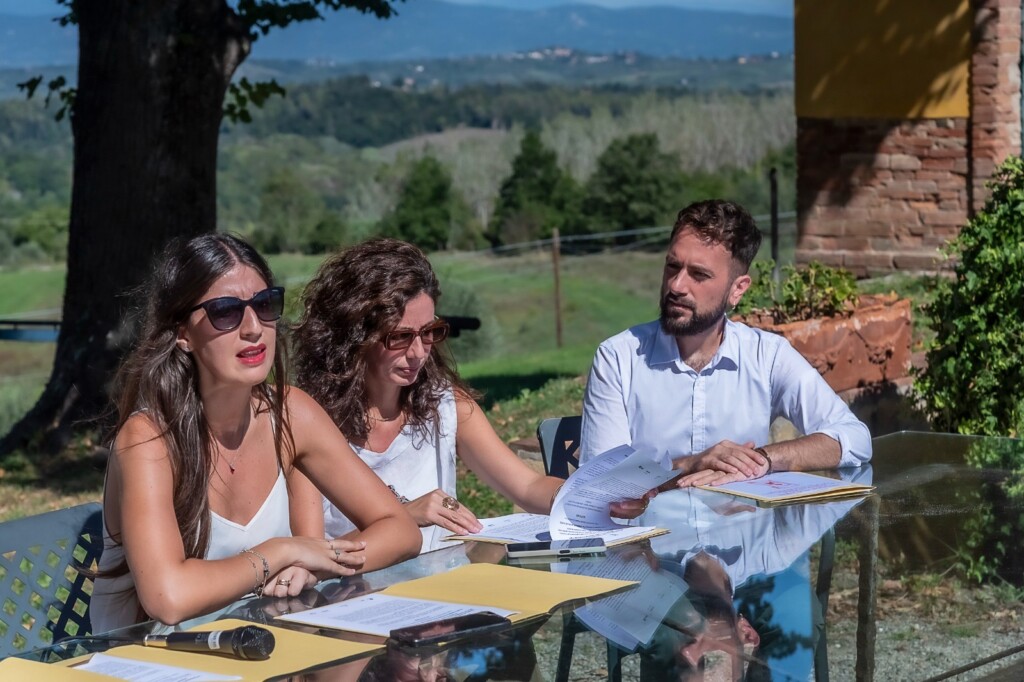
“We are proud and grateful for this collaboration, which forms part of a wider initiative towards a ‘Castelfiorentino House of Artists’, through a ‘plan’ of artist residencies aimed at defining the town along three fundamental axes: cultural, social and identity-based, and in the spirit of the civic patronage that has historically characterised it. – said Mayor Francesca Giannì and Councillor for Culture Franco Spina – The local council and the citizens are becoming patrons, working on behalf of young artists, literally giving them a place to live where they can create art through engagement with the town, transforming Castelfiorentino into the chosen home of artists and culture. Projecting Castelfiorentino into the realm of beauty and artistic exploration also depends on this. A bold utopia, which can become a reality.”
“WONDERFUL! is a concrete example of how Florence can be not only a place where culture is produced and enjoyed, but also the driving force behind a cultural system capable of engaging and enhancing the entire metropolitan area,” said Giovanni Bettarini, Councillor for Culture for the City of Florence. “Bringing the research and creativity of young artists outside traditional spaces means building new relationships between Florence, the local councils and local communities.” Aronne Pleuteri’s work in Coiano is the result of this vision: a project that takes its starting point from Florence and its cultural heritage to engage with the local area, the Via Francigena and the people who travel along it, demonstrating just how much contemporary art can be a tool for understanding, participation and the promotion of places.”
Claudia Sereni, metropolitan councillor responsible for Culture, had this to say about the initiative: “The Wonderful! project creates a dialogue between the history of the metropolitan areas and contemporary art. I am proud of the result of this collaboration between the artist residencies we support and the public space. The Via Francigena is enriched by a site-specific artwork that invites pilgrims and travellers who walk its route each year to reflect on the relationship between action and inactivity, presence and observation.”
“We welcome with great satisfaction the announcement of the five winners – four female artists and one male artist – who, through their talent, will give voice to Italian creativity on the international stage. Thanks to the network of Italian Cultural Institutes, these young artists will have the opportunity to engage with new artistic contexts and showcase the vitality of contemporary Italian artistic research abroad. Each of them will make a unique contribution, strengthening the role of the Italian Cultural Institutes as spaces for cultural exchange and dialogue, and reinforcing Italy’s image as a country that supports and promotes new generations of artists, offering them opportunities for growth on a global scale,” said Minister Plenipotentiary Filippo La Rosa, Central Director for the Promotion of Italian Culture and Language, Directorate-General for Public and Cultural Diplomacy, Ministry of Foreign Affairs and International Cooperation.
“With PRIMO, a street cinema project designed to observe life as it unfolds, Aronne Pleuteri makes a gesture that is as simple as it is radical: he takes art out of its usual venues and creates, along the Via Francigena, a setting capable of transforming an everyday journey into an experience of observation.” – said Sergio Risaliti, Artistic Director of the Museo Novecento in Florence – In this sense, the project fully embodies the spirit of the second edition of WONDERFUL! Art Research Programme – Maria Manetti and Jan Shrem Foundation: supporting the research of young artists by placing them in direct contact with local areas, their communities and their landscapes. This edition involved five municipalities within the Metropolitan City of Florence, inviting the artists to engage with different contexts and communities, and further expanded the scope of the research through the valuable collaboration with the Ministry of Foreign Affairs and International Cooperation, offering participants the opportunity to continue their journey with a residency at the Italian Cultural Institutes abroad. Pleuteri’s work thus reminds us that even public space can become a place for the creation and experience of art, when the artist does not merely occupy it, but succeeds in temporarily altering the way in which we move through it, inhabit it and view it.
“Special thanks go to the Metropolitan City, to Mayor Francesca Giannì and to Councillor Franco Spina, who have embraced and supported this project with sensitivity and passion, as well as to the Ministry of Foreign Affairs. Finally, I would like to thank Maria Manetti Shrem for the invaluable support she has provided to the residencies at the Museo Novecento”.
“PRIMO Cinema di Strada is a frame. We can use it to frame reality, pause to observe it for as long as we deem necessary, and stop when we no longer feel the need. It is a pause, a parenthesis in the flow of our lives.” – said Stefania Rispoli, curator of the Museo Novecento – Art, very often, is precisely this: a stumbling block, something we come across without having sought it out and without a specific purpose. By its very nature, it is not functional, but it exists because an artist felt the urge to bring it into being and, once created, it occupies a place and a time amongst the many things that inhabit our spaces. In a sense, it is a gift for those lucky enough to encounter it.
Primo Cinema di Strada fully reflects the nature and artistic vision of its creator, Aronne Pleuteri, and confirms the fascination he had sparked in us when we first met him, upon selecting him for the Museo Novecento’s Artist-in-Residence programme. His work is unpredictable, irreverent and poetic, tragicomic; it possesses something of ancient tragedy, yet also echoes Pasolini in its ability to invite us to view reality through it, unfiltered, whilst seeking to cast aside conventions.
After months of research, seeing this work realised brings great joy and pays tribute to the Municipality of Castelfiorentino, which has chosen to invest in contemporary production and young artists, building on a local tradition linked to the performing arts and theatre. His commitment seems to look simultaneously to the past, the present and the future, so that it is still possible to stumble upon an artist and their work, to stop, take one’s time and let something happen.”
The work is the first site-specific installation to be unveiled as part of the second edition of WONDERFUL! Art Research Programme – 2nd edition Maria Manetti and Jan Shrem Foundation, the artist residency programme promoted by the Museo Novecento in Florence in collaboration with the Metropolitan City of Florence and a number of Tuscan municipalities, including Castelfiorentino. Located in Coiano, along one of Europe’s most important historic routes, PRIMO – a street cinema for observing life as it unfolds – also brings a contemporary art intervention directly to the Via Francigena, travelled each year by thousands of pilgrims and travellers.
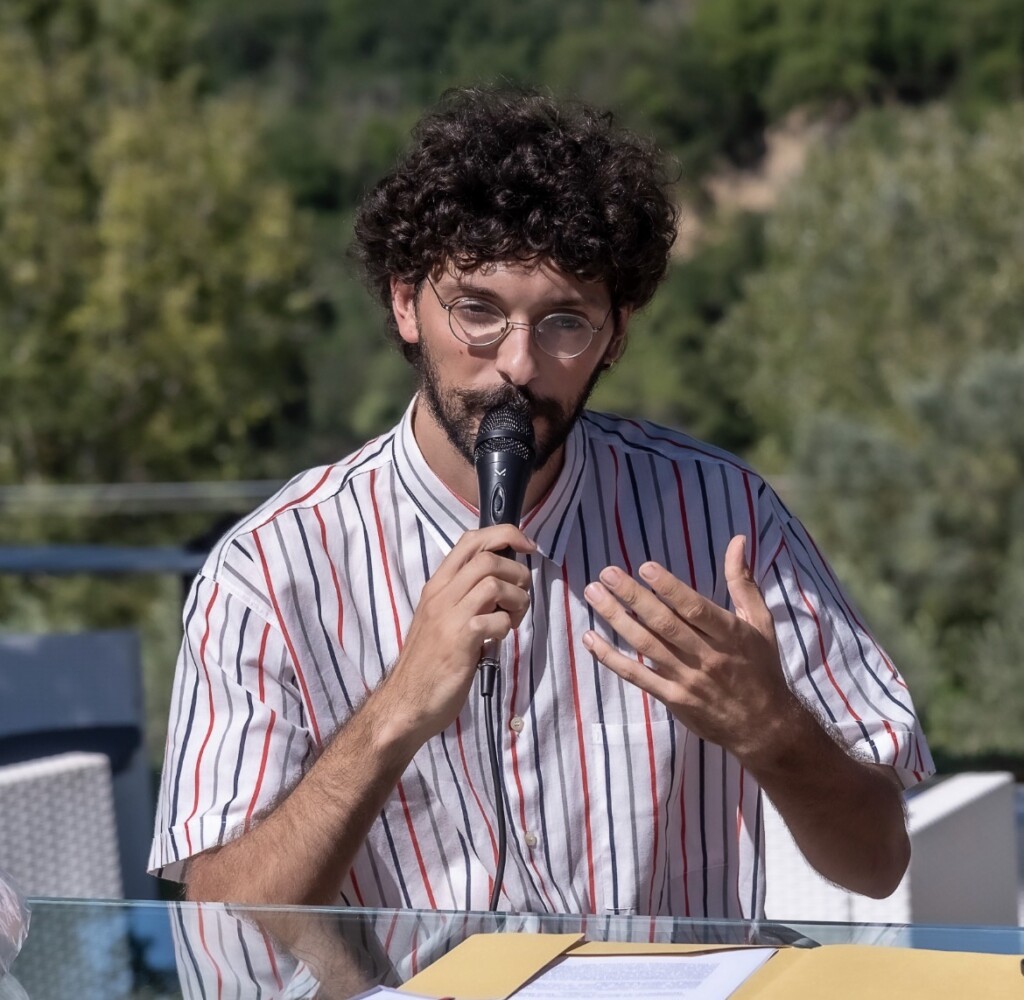
Born in Erba in 2001, Aronne Pleuteri is an artist and performer. Trained at the Brera Academy, he has developed an artistic practice expressed through painting, drawing, installation, video and performance, using paradox, humour and failure to challenge the conventions through which we interpret reality.
During the ‘Wonderful! Art Research Programme – 2nd edition’ residency programme organised by the Maria Manetti and Jan Shrem Foundation, which aims to support young artists, he was invited to collaborate with the Municipality of Castelfiorentino to create a work for the local area.
The work created for the Municipality of Castelfiorentino stems precisely from a reflection on the relationship between action and inactivity, presence and observation, and brings into the public space a seemingly simple, ironic installation which, rather than staging a performance, transforms reality itself into something to be looked at. The ‘cinema’ has no screen and does not project images: before the viewer’s eyes pass the street, the landscape, the pilgrims, the locals and the passage of everyday life. An invitation to pause and observe what we normally pass by without seeing.
The installation consists of just a few essential elements: a canopy, a stool and an illuminated sign reminiscent of those found in the theatres and cinemas of yesteryear, on which the title of the work stands out: ‘First street cinema for observing life as it flows’, which is also an invitation to participate so that the work may be realised.
There is nothing to see in the traditional sense of the word because the spectacle is already there: it is the street, the landscape, the people, the animals, time and life as they flow by.
The choice of Coiano and the Via Francigena takes on a special significance in this sense.
Aronne Pleuteri’s installation is situated along a route centred on movement, travel and the journey, and introduces, within it, a seemingly contradictory possibility: that of coming to a halt. The pilgrim travelling through the landscape is invited to pause for a moment on their journey and become a spectator of the world that continues on its course. The words on the sign thus transform an everyday, anonymous gesture such as sitting down into ‘a possible existential posture’ and allow one to temporarily escape the obligation to act, making way for observation. The visitor is invited to sit down, to contemplate, laugh or grow bored. They may wait for something to happen or recognise that something is already happening. The street thus becomes the screen of the first street cinema: an image in constant motion, without a director and without an ending.
“Is the ‘First Street Cinema for Observing Life as It Flows’ a work of art, a phantom theatre, a road sign, or, more likely, a designer bench?” explains Aronne Pleuteri. “The pilgrim on the Via Francigena who comes across the hamlet of Coiano on their journey cannot fail to notice an unusual structure.
A Broadway-style illuminated sign bearing the title of the same name towers above a small raised platform with a few steps and a minimalist stool. Written in black on white, it is the words that transform the anonymous act of sitting into an extreme, radical existential posture of ascetic subtraction: it is the flow of life itself that holds, within itself, in its very unfolding, a spectacle that is already marvellous, one which, tragically, ought to render ridiculous any other attempt to act artistically in the world.”
PRIMO CINEMA di Strada thus questions the threshold between Life and Work of Art, but even before that, between Reality and Representation; a threshold that is not blurred, but a very precise moment that we choose to mark in time. A possibility to be made possible, in our case, thanks to a stool, a sign and its nominal power.
The artist, thus, disappears, but in an eclipse that is only apparent: he exists in the frame for the painting, in the spotlights trained on the stage for Tonight’s Grand Show, in the armchairs for a cinema without a screen.
The first street cinema, in a delirious mystical and ecosophical claim, is capable of triggering a gaze – but one that is entirely inward. It invites the visitor to sit down, contemplate, laugh, grow bored and, once back on their own path, to take responsibility themselves for surrendering to the great spectacle of existence.
WONDERFUL! Art Research Programme – Maria Manetti and Jan Shrem Foundation
WONDERFUL! Art Research Programme is an artist residency project conceived by the Museo Novecento in Florence under the artistic direction of Sergio Risaliti and curated by Stefania Rispoli, organised by Fondazione MUS.E, and supported by the City of Florence and the Maria Manetti and Jan Shrem Foundation.
The programme was established to offer young artists living in Italy the opportunity to spend a period of research in Florence and Tuscany – places that for centuries have been hotbeds of ideas, sources of inspiration and a home for artists – living both within the walls of a museum and beyond them.
The second edition of the programme took place in collaboration with the Metropolitan City of Florence between 2025 and 2026 and featured the artists Mara Callegaro, Virginia Russolo, Beatrice Celli, Agnese Galiotto and Aronne Pleuteri, who, thanks to a research grant, had the opportunity to develop the concept for a new work for five municipalities: Castelfiorentino, Vinci, Montelupo Fiorentino, Scandicci and Empoli. In addition to the residency experience in Tuscany, the artists were given the opportunity to spend a month abroad at the Italian Cultural Institutes in Santiago de Chile, Sydney and Almaty in Kazakhstan, thanks to the generous support of the Ministry of Foreign Affairs and International Cooperation.
Biography of Aronne Pleuteri
Aronne Pleuteri (Erba, 2001) lives and works in Milan, where he studied at the Brera Academy, graduating with a degree in painting. His thesis on ‘The Figure of the Dwarf as a Point of Friction between the Real and the Imaginary’ (March 2023, subsequently published) culminated in a basketball match between dwarfs and giants in the Brera courtyard, organised in collaboration with the Obelisco Production collective. A painter, sculptor and performer with a Dadaist sensibility, he integrates painting, music and collective practices. Among his best-known initiatives are the Laboratorio Quasi 33, a research space dedicated to silence and the practices of inaction, and the ‘mototrombe’, performative sculptures designed to illegally invade traffic by imitating its noise. A finalist in the twenty-third edition of the Cairo Prize (2023), he is the youngest artist in the Iannaccone Collection and took part in the 2025 exhibition Italian Art Today. A New Scene (Triennale di Milano, now on tour). Recently, he designed one of the posters for the Milan-Cortina 2026 Olympic Games.
Aronne Pleuteri’s residency programme has also taken on an international dimension. Thanks to the invaluable support of the Ministry of Foreign Affairs and International Cooperation, Pleuteri had the opportunity to spend a month in Kazakhstan, further broadening his field of research and exchange.
UFFICIO STAMPA
Museo Novecento
Camilla Fatticcioni
T. +39 3342561755
E. pressmuseonovecento@musefirenze.it
Comune di Castelfiorentino
Alessandro Spinelli
T. 0571 686307 \ 347 1030958
a.spinelli@comune.castelfiorentino.fi.it