
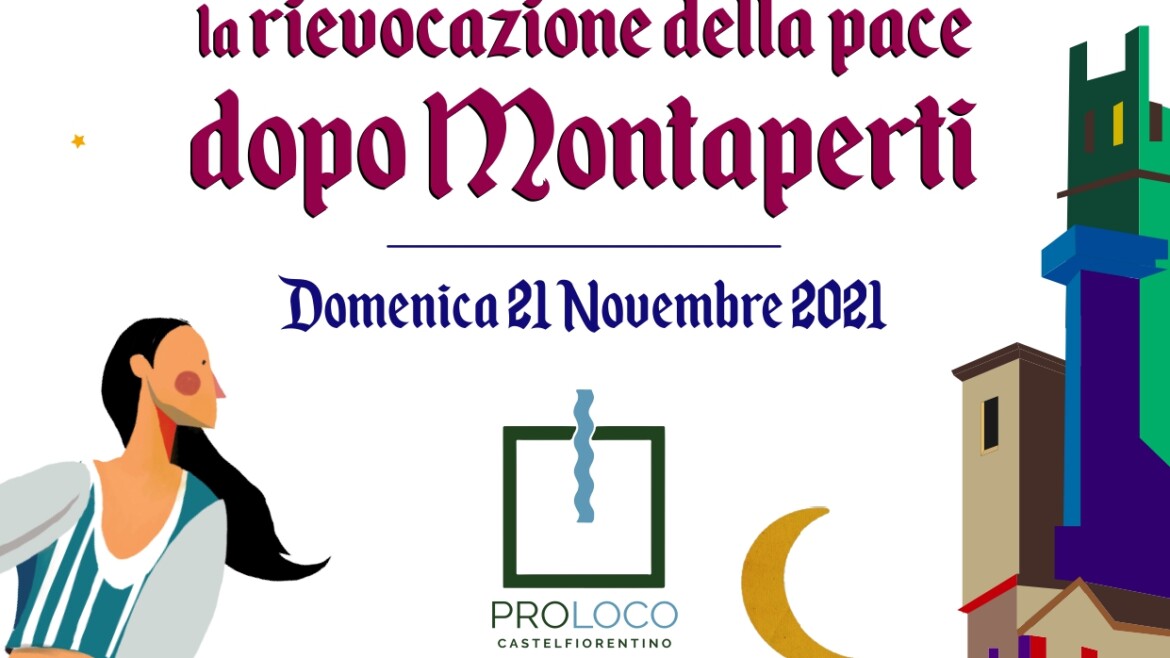
Sunday, November 21st the historical reenactment with a market of arts and crafts, medieval games
and the participation of the Historical Court of Florence and the Historical Court of Monteriggioni
Halberdiers and foot soldiers of the corporations. Gonfalonieri of the Arts, Officers of the Infantry, Bombardiers. Musicians and Banners of the Uffizi. A thunderous roll of drums will accompany Sunday, November 21st the Historical Procession of Florence and the Historical Procession of Monteriggioni for the commemoration of the Peace stipulated in Castelfiorentino in 1260 between the Ghibelline Siena and the Guelph Florence, at the conclusion of the bloody battle of Montaperti.
Seventy-five people in medieval costumes will walk along the streets of the old town center, both high and low, starting at 3.30 p.m., until they reach the medieval market in Piazza Kennedy and head for Piazza del Popolo, where the processions and the institutional representatives will give life to the solemn ceremony of the “signing” of the Peace Treaty, preceded by the ringing sound of the “chiarine”.
Starting at 10.00 a.m., Castelfiorentino will be immersed in the atmosphere of the period with a medieval arts and crafts market in Piazza Kennedy, with the activities that characterized the economy of a small community in the 13th century: leather working, weaving, parchment, handmade paper, bookbinding, copper working, candle making, calligraphy, barbitoning. It will also be set up a play area “theme”, dedicated to children and bordered by a large setting in which they can participate in group games, inspired by the medieval knightly tournaments (jousting, crossbow shooting, etc. …). In the space reserved for didactics, children can also try their hand at the construction of medieval games such as the catapult and the wooden spinning top. There will even be a reconstruction of a real carpentry: wood, hammers, nails for the free construction of objects.
In the afternoon, the Historical Parades of Florence and Monteriggioni will gather in Piazza Gramsci for the departure, scheduled at 15.30, and will follow a double itinerary: before and after the signing of the peace treaty in Piazza del Popolo (the latter scheduled between 16.00 and 16.30). The first itinerary (3.30 p.m.-4.00 p.m.) will take in Piazza Gramsci, Corso Matteotti, Via Volontari del Sangue, Via Bovio, Piazza Kennedy (ring), Via Bovio, Via Volontari del Sangue, Via Ferruccio (Arco de “La Costa”) and finally Piazza del Popolo, where the two processions will be welcomed by the Castelfiorentino School of Music. The second itinerary (after the signing, from 16.30 onwards) will go down from Via Ferruccio (Arco de “La Costa”), Via Volontari del Sangue, Via Bovio, Piazza Kennedy (ring), Via Bovio, Via Garibaldi (Corteo Storico Monteriggioni), Corso Matteotti (Corteo Storico di Firenze) with diversified return of the two processions in Piazza del Popolo and Piazza Gramsci.
In the streets of the center, from 16.00 onwards, there will be “flash mobs” in medieval costumes and the grand finale will be in Piazza Gramsci (near the obelisk) with an exhibition of flag-wavers.
“It will be a beautiful celebration – underlines the Mayor, Alessio Falorni – in memory of an important historical moment for Castelfiorentino, the place chosen by the Ghibelline Siena and the Guelph Florence to sign the Peace Treaty at the end of a bloody war, “the great havoc” narrated by Dante in the Divine Comedy which left more than ten thousand dead on the field. It is also for this reason that the Peace signed on 25 November 1260 in Castelfiorentino, which is not coincidentally depicted in the Historic Curtain of the Teatro del Popolo, takes on a noble meaning that makes us particularly proud. Because it makes our community a land where conflicts are resolved, where convergence and possible solutions are sought. In other words, a land of peace.”
THE CARD
Around the middle of the 13th century Tuscany was divided into independent states, divided into Communes (made up of cities and castles) and Seigniories, headed by noble families that had their own domains. The frictions and the divergences that could lead to conflicts were generated on two levels, which often intersected: the territorial one, perhaps fed by border issues, spheres of influence, commercial rivalries; and the political one, based on the clash and the alliance between the three parties: Guelphs, Ghibellines, common people. The first, as is known, were linked to the Papacy. The second to the Empire, in the persons of the Swabian sovereigns. The common people represented local interests and had no authority of reference. The factor that aggravated the crises between states was the ability of Guelphs and Ghibellines to create alliances sovralocali, dividing within them the ruling classes. After the death of Emperor Frederick II of Swabia, in 1250, in Florence was imposed a regime popolano, which thanks to a policy of equidistance between the two parties in the game had managed to gradually extend its influence. The ghibellini, however, reacted of forehead to this situation: and in two occasions (1251 and 1258) they organized of the revolts, ending up to take refuge – in 1258 – to Siena in exile. The pressure of the Florentine Ghibelline refugees, and the promises of military help from the last Swabian sovereign (Manfredi, King of Sicily, natural son of Emperor Frederick II) convinced Siena to violate the commercial agreement of 1255 (the “society”), challenging Florence. The latter reacted by organizing a military campaign in the summer of 1260, resulting in the disaster of Montaperti, where the Florentine army was heavily defeated by that of Siena. The “slaughter” of the Florentines was such as to be remembered by Dante Alighieri in the “Divine Comedy” (Inferno, Canto X) as “the torment and the great havoc that the Arbia coloured in red”. On a political level, the military defeat inevitably led to the fall of the popular regime of Florence and its allies (with the sole exception of Lucca), reducing its role in Tuscany.
The Peace after Montaperti (Castelfiorentino, 25 November 1260)
The political and territorial reorganization of the region took place through the signing – on the 25th November 1260 – of two agreements between the Communes of Florence and Siena. The signing took place in a place near Castelfiorentino, at that time a Commune subject to Florence, a place of strong strategic value for the control of Valdelsa, over which Siena wanted to extend its influence.
According to the practice of the time, the Communes of Florence and Siena were represented by Mayors – in practice special attorneys, according to current legal terminology – who were designated ad hoc: Lotteringo del fu messer Ubertino di Pegolotto for Florence, and messer Iacopo di Pagliarese and Buonaguida del fu Gregorio di Boccaccio for Siena. Let us examine them separately:
1) With the first agreement, Florence ceded “rights”, public and private, held in a series of communities (Montepulciano, Montalcino, Poggibonsi, Staggia, etc.) and seigniories. These “rights” – iura in the text, from the Latin ius-iuris – were understood at the time as legal relations such as private property, sovereigns such as the collection of taxes, and personal bonds of loyalty and subordination in this case impossible to define for lack of detail. In essence, this agreement sanctioned the passage of communities and lords from the control of Florence to that of Siena.
2) The second agreement, called the “society”, was assimilated to a real peace treaty. Through it, the two former belligerents put an end to their disputes, regulated the question of prisoners of war, committed themselves to recognizing their respective jurisdictions, promised each other help and assistance and stipulated a new commercial agreement of free trade.